DTAS Members’ Survey 2026: what members told us and what it means
Development trusts play a vital role in communities across Scotland, supporting local economies, delivering essential services and activities, creating opportunities and managing assets for community benefit.
Our 2026 Members’ Survey brings together responses from 172 member organisations — around half of the DTAS membership and very similar to the 173 responses received in 2023. Respondents’ area types and deprivation profiles closely match those of our wider membership, giving us a useful picture of the development trust movement today.
How DTAS will use the evidence
The findings provide a reflection of the vast range of activities development trusts are delivering and their economic and social impact. This gives us essential evidence to build our case on a national level and advocate on behalf of our members across policy areas such as community ownership, funding and investment, local democracy, community wealth building and public service reform.
The evidence will also help us respond to the changing needs of our members and adapt our services around people and wellbeing, governance, funding, assets and community energy.
Summary of findings
The findings show a movement that is active, ambitious and responding to growing demand, but also facing increasing pressure on people, funding and organisational capacity.
They highlight both the scale of what development trusts are delivering across Scotland and the support members need to sustain and grow that work.
A growing demand
Members work across culture, tourism and events; environment and climate; community and social services; education and sport; economy and enterprise; and housing and transport. Almost all respondents run their own activities, and around one in five also give grants or donations to local organisations or individuals.
More than half of members said they had delivered much of what they planned in the previous year. Where plans were delayed or could not be completed, respondents commonly cited limited staff or volunteer capacity, funding shortfalls and external delays.
People and governance
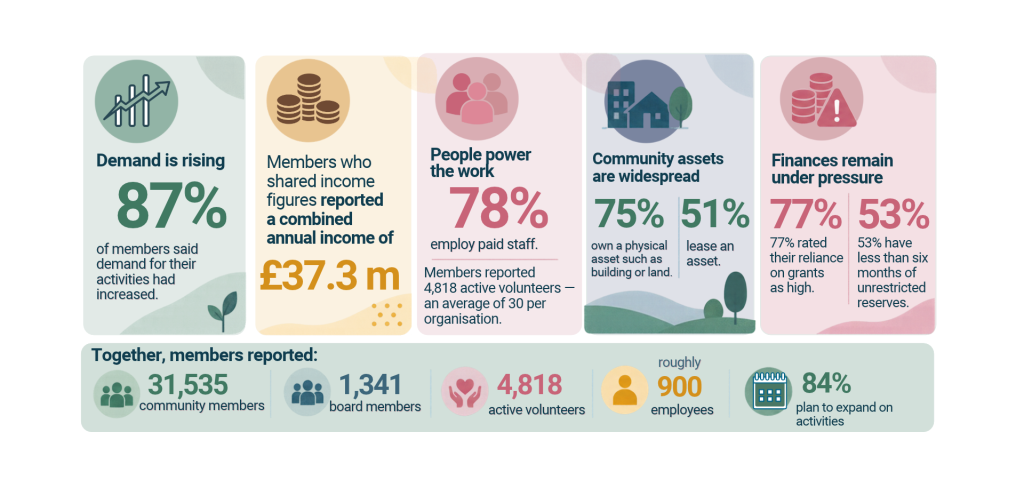
The majority of members employ paid staff, but volunteers remain fundamental to how development trusts operate. Across respondents, members reported 4,818 active volunteers compared with roughly 900 paid employees — more than five volunteers for every member of staff.
Paid staff help members coordinate volunteers, strengthen financial management and develop their work. But people capacity is also a major pressure. Volunteer shortages were the most frequently reported barrier to resilience, and around half of employers said staff wellbeing had been a significant challenge or a challenge to some extent in the past year.
The survey also highlights questions about board recruitment and representation. Recruitment is mainly through word of mouth. Members often described difficulty attracting younger trustees and ensuring boards reflect the communities they serve.
Funding, reserves and assets
Members use a mix of grants, trading and other income, however around a half of members rated themselves 5 out of 5 for grant reliance. Sales and hiring out space or equipment are common ways to earn income. The median share of income from trading and enterprise was 20%.
Over half of respondents hold less than six months of unrestricted reserves. This sits alongside rising costs and reports of funding delays or reductions.
Three-quarters of respondents own a physical asset, and leasing has become more common since 2023. Community buildings, land and other buildings feature prominently. Some assets also generate income, and nearly one in five respondents reported owning some renewable energy capacity. Members who had gone through an asset acquisition described the process as time-consuming, complex and costly.
How experiences vary by place
The survey shows that members’ circumstances differ across Scotland. Remote rural trusts are especially likely to own assets, while reporting fewer active volunteers on average. Urban trusts are more likely to lease than own assets and are much less likely to receive community benefit funds. Small-town trusts are the most likely to employ paid staff.
The report also finds differences by area deprivation. Trusts in more deprived areas are more likely to employ staff. Members in the least deprived areas reported the highest average number of volunteers, but the lowest average sense of resilience. These findings underline that a single overall picture can hide different local conditions.
How the findings compare with the wider third sector
The report compares DTAS findings with SCVO’s Third Sector Tracker. Both surveys identify funding, rising costs, volunteer recruitment and limited reserves as pressures. The questions and time periods differ, so these comparisons show broad patterns rather than precise like-for-like differences.